

Few things are as enraging as someone messing with your food. It is something which is capable of arousing a primal fury like no other, and it is perhaps unsurprising that a food related offence made it into Hesiod’s poetic retelling of the human origin story. At a sacrifice at Mecone, the Titan Prometheus, responsible for shaping mortal man out of clay, divided an ox into two portions, concealing the edible meat underneath the unappealing stomach, while hiding the bones of the animal under a tempting layer of glistening fat. Zeus, taken in by this deception, chose the latter, and in retaliation deprived humans of fire.
Prometheus however, unwilling to accept this punishment, stole fire back and hid it in the hollow stalk of a fennel plant, carrying it down from the gods to mankind. On discovering what Prometheus had done, Zeus decided that if man was to have fire, it would come with a gift that they would delight in even as it brought about their misfortune. So, in a move that no doubt sheds some light on the Ancient Greek social structure, Zeus ordered Hephaestus to mould a woman from earth and water, allowing all the gods of the pantheon to bestow upon her a gift. Athena dressed her and taught her the art of weaving; Aphrodite endowed her with beauty and desire while Hermes gave her speech, cunning and deceit.
Zeus, lacking no cunning of his own, then sent her to Prometheus’ brother, Epimetheus, who despite his brother’s warning never to accept a gift from Zeus made her his wife. As a wedding gift, Zeus then presented Pandora with a large storage jar known as a pithos, along with strict instructions never to open it, knowing that curiosity would inevitably get the better of her…
Most will of course be familiar with how the tale ends, for contained within the jar, later mis-translated as box, lay all the countless evils of the world. As Pandora opened the jar, sorrow, disease, vice, violence, greed, madness, old age and death sprang forth to plague humankind forever.
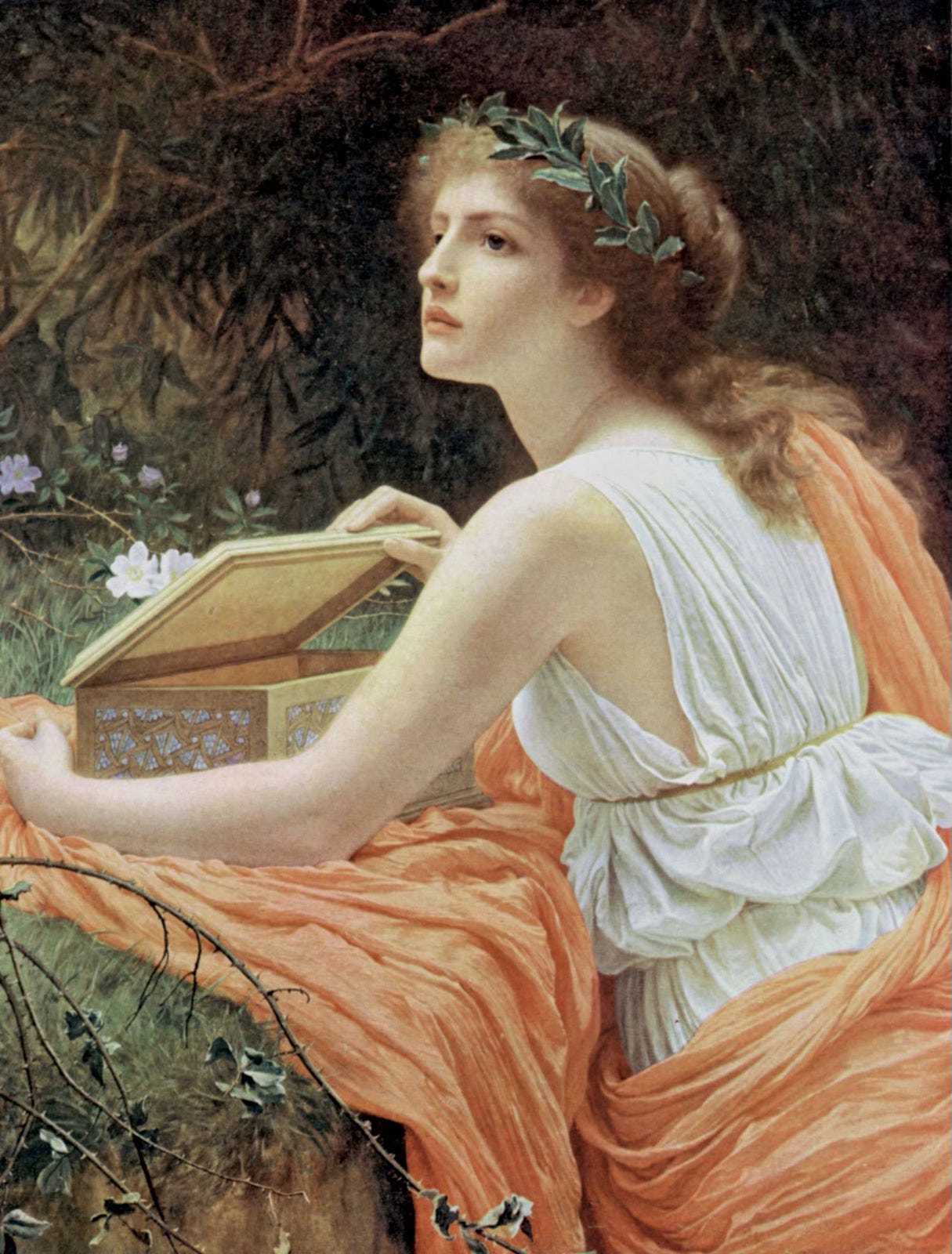
Opening the Box
The tale of Pandora’s box is a compelling story, and it is one that has been used countless times as a metaphor for actions that have irreversible consequences. As we as a species grapple with an ever increasing understanding of the world around us, we regularly explore new technologies without fully being aware of the impact they might have on our lives and future. Often, as was the case with Pandora, it is curiosity that drives us, perhaps mixed with awe of our own ingenuity and a desire for financial gain.
A recent example of this, and the reason why I have chosen to start this article with the story of Pandora, is of course the release of large language models (LLM), often referred to as AI, into the public sector. For the first time, we can now interact with the machines we have built using natural language, and receive what appears to be reasoned responses in return. While an absolute game changer in how our future interactions with computers will look like, it also raises philosophical questions about sentience and, in some ways, what it means to be human. The more immediate impact however is the ability for anyone using a simple prompt to generate a tremendous volume of increasingly convincing text or imagery that with the current state of the technology can be very hard to distinguish from something a human has produced.
The morality of passing the output of an LLM off as human writing has received a great deal of attention recently, and in the small world of wine writing, one particular instance of suspected AI use has caused quite a stir. For those that do not follow or subscribe to a large number of other wine writers on Substack, and who may not know what I am referring to, I am talking about the small scandal involving the 2026 winner of the 67 Pall Mall Awards for best global wine communicator in short-form writing, who has been accused of submitting a piece that for many commentators has all the tell-tale signs of being AI generated.

While the winner of this award, Fikayo Ifaturoti, has not offered much by way of commentary, and the organisers of the award have defended their decision repeatedly, this alleged use of AI to win a prestigious award, and a non-trivial cash prize, has sparked widespread debate and anger. While the particulars of this scandal has received excellent and balanced coverage by Henry Jeffreys, Alice Feiring and Felicity Carter, there are aspects of this debate, and the role of AI in the context of wine more generally, that I want to take a closer look at.
The Imitation of Experience
For many, outsourcing the act of writing to a machine, and with it the painstaking effort needed to convert thoughts, experiences and judgement into language, is deeply troubling. There is little doubt that removing the skill and human experience that underpins great writing from the equation devalues the hard earned skill that so many have spent years acquiring. After all, if the end product is practically indistinguishable from the real thing, why should we bother writing anything at all? Should we not be glad that the days of staring at a blank page as our thoughts gather pace can be wholly replaced by an instantly gratifying command? What if you too could write with the sharp detachment of Hemingway or the meticulous detail of Tolstoy, just by pressing a couple of buttons?
While I would hope the answer to that is fairly obvious, it appears that the dopamine rush associated with bypassing cognitive effort is too big of a temptation for many to resist. Setting the ethical problem of passing something that you did not write yourself off as your own aside for a moment, there is an underlying problem that arises when what is being discussed is intrinsically linked to, and informed by, the human experience. Though the best large language models show an apparent ability to reason, something which seems to be an emergent property of millions to trillions of nodes that predict the next word in a body of text, it can never actually partake in the sensory world it discusses. Therefore, while these AI models may be able to create a convincing simile of wine critique or string together a reasonably convincing, and grammatically correct sentence, it remains a probabilistic exercise that will inevitably be lacking in true substance.
What gives a book like Hemingway’s For Whom the Bell Tolls its devastatingly powerful depictions of human suffering and allowed it to symbolise the Spanish Civil War in the public imagination was his own direct experience of the conflict it described. While wine writing has no business taking itself too seriously, or comparing itself to literary masterpieces, it can only be done well when informed by the direct experiences of the wine it discusses. More importantly, and what I believe separates great wine writing from the rest, is its ability to portray the broader human experience through the lens of this seemingly insignificant liquid, within which resides an almost mystical potential to amplify every human emotion. It is something that might be approximated, but which cannot be properly done by a machine. Even if you were to connect one of these language models to the requisite sensors for a full chemical analysis of the wine, thus enabling it to describe a wine on the basis of perceived inputs, the bigger question we as its creators need to ask is quite simple.
Why?
AI In The Wild
On a recent trip to Bologna, I came across an unusual concept for a wine bar which appears to have fully embraced generative AI, and offers one of the first hands on implementations of AI for wine that I have come across. Bottega Botlé as the place is called, is freely decorated with a range of colourful AI generated images of vines and vineyards in a style that is best described as slop. Being on holiday, and thus generously minded, I remember noting that at the very least this slop was consistent, and so blatantly obvious in its AI-ness, that nobody could accuse them of pretending otherwise. In fact, AI integration was quite clearly part of the selling point of this place which while functioning like a normal wine bar with automatic dispensers, lets guests connect their purchases to an AI driven program called Rewine, which can be accessed by tapping a card to one of several table-side tablets. The purpose of this was relatively straightforward and well explained by the friendly (human) staff. In addition to quickly letting you pull up tech sheets and information on the wines, the program features a “sommelier game” where it asks you a series of decently formulated questions about the appearance, smell, structure and taste of the wine with multiple choice answers. When you have completed the exercise it gives you a score out of 100 based on how accurately you are able to match the wine in your glass to the correct answers.


I won’t pretend it wasn’t a little fun, but after a go or two it lost its appeal and I don’t know if I would like to do it again. The screen ends up pulling you in, demanding that attention be spent on the gamified tasting process rather than the people you’re with, and all aspects of the experience suffer as a result. Furthermore, the use of AI generated content to assess your accuracy, or ability to taste and describe a wine is a slippery slope and effectively forces the user to second guess their own reality in favour of that generated by a machine that has not, and never will, truly experience a wine. It is bad enough when we over-rely on tasting notes produced by a human, but entrusting a machine with the validation of our own senses seems meaningless, if not even dangerous.
Based on the information on Rewine’s website, the establishment using their system need only enter the name of the wine, the winery and the vintage for a given wine and the system will automatically generate a complete description, technical sheet and producer profile. They claim that the entry process has been tested in their stores and has proven to be fast, practical, and efficient. Nowhere does it say accurate, and I have my doubts it could be. At first glance, and with something relatively obvious like a Barbaresco, it performed quite well. Or rather, I did, scoring 95/100 points on the test. But the longer I played with it the more obvious it became that for some wines the answer it demanded simply did not match my experience of the wine. As a result my score suffered, and had I not known better I might have decided the fault lay with me and that my senses are too dull to accurately assess the wine in front of me.
The worst part is that there is nothing about that software that really requires AI in the first place. The descriptions would be more accurate if based on a quick human assessment by someone moderately qualified, the tech sheets could be verified with the winery and the profiles could be written and fact checked by a human. But of course that is work, and it takes time and some degree of skill, both of which cost money or effort, and possibly a combination of both.
It is also completely unnecessary. When I go to wine bars with dispensers of this sort, the Vagabond chain in London being a good example, I frequently arrange small blind tastings using the small 25ml samples they let you buy. Going through the basic look, sniff, taste, assess process, it is a fun, loosely structured activity that lets you discuss the wine and exercise your blind tasting muscles. While the complete novice would not be able to “call” the wine, a simple card by each table explaining the general process would I believe be as useful, and certainly more socially rewarding, than the fixed format Rewine offers. I should add that blind tasting is as pointless as it is hard, but nevertheless, it can be fun.
None of this put a damper on the unbridled enthusiasm displayed by a fellow guest at Bottega Botlé however, when he proudly announced to a staff member that he had managed to score 97 points on a wine. Well done, I suppose.

Final Thoughts
When Pandora saw what came forth from the jar, she quickly put the stopper back in, but it was too late. The evils she had unwittingly unleashed upon the world could not be put back, and disease, sorrow and mortality would become the condition of human life. Yet her quick action had prevented one thing from escaping, and at the bottom of Pandora’s jar lay hope. This of course has been interpreted in many ways, but the broadly optimistic reading is that keeping hope inside means it was preserved for humanity, acting as a vital counterweight to what had been released.
While (allegedly) using generative AI to win a writing competition is the wrong use-case, algorithms relying on large neural networks are a phenomenally complex, yet powerful set of tools that allow us to train a wide range of models with genuinely helpful use cases that extend our capabilities rather than merely replacing them. One such example would be large scale, real time pattern recognition across quantities of data humans cannot readily process, while leaving judgement, observation and action with the human operator. Among other things, this can be used in precision agriculture to rapidly, and with sufficient accuracy, identify potential problems with a crop. Paired with drone mounted broad spectrum sensors that can scan a vineyard, it becomes possible to rapidly identify areas with high disease pressure or water stress, highlighting areas in which the grower might need to inspect the vines and take corrective measures as necessary. For large scale operations this can save a substantial amount of time and money, while improving grape quality in the process.
Viewed this way, as a limited tool to augment human capability, AI will become increasingly indispensable, and there is good reason to be hopeful in this regard. Optimisation algorithms we can interact with on a natural language level can reduce fuel usage, improve irrigation efficiency, detect disease pressures at an early stage and minimise the use of pesticides, all while improving the economic efficiency of the farming operation.
That said, the potential downsides with this technology going unchecked is worthy of concern and whoever unleashes a rouge AI with recursive self-improvement capabilities might as well call it Skynet and connect the circle of poetic justice that some fear is around the corner. In the meantime, enjoy a nice glass of wine and keep on writing and thinking for yourself. It’s good for you.
Pay-to-play medals and cut-and-paste tasting notes do more damage to wine culture than any bad vintages ever could. Thank you for reminding us what honest wine communication should actually look like. Pure gold as always, George.
I commented on the use of a 'bot' to write tasting notes prior to this Pall Mall kerfuffle. I see many Substack entries now with a note (mine included) that the writing is entirely human-generated. The fact that so far at least the author of this prize-winning essay has not been transparent about its origins is damning in my view. Thank you George as always for an enlightened and entertaining piece.