
Licking Rocks
Understanding Minerality and How Soil Function Shapes Wine

As with many of the topics that routinely crop up for discussion in the world of wine, the question of minerality, and what is actually meant by it, is perhaps best described as being of niche interest. For all that, it appears with remarkable regularity and is often paired with adjectives intended to elaborate on a wine’s structure or hint at the soil from which it came. Visit a tasting room pouring higher-acid whites, or read through their notes, and you would be hard pressed to avoid mentions of linear, racy or fresh minerality, not to mention chalky, saline or gravelly equivalents.
At best, minerality functions as a loosely constructed catch-all phrase, an attempt to give language to a combined perception of acidity, texture, restraint of fruit and perhaps even subtle reductive elements that shape a wine’s profile. At worst, it becomes untethered from plausibility, drifting into phrases such as wet slate, crushed granite or river stones warmed by the sun.
The issue is not merely one of linguistic redundancy. Such descriptions often attempt to draw a straight line between the perfectly sound concept of terroir and the sensory expression of a particular wine, while sidestepping the actual mechanisms involved. They imply a direct chemical link between geology and flavour, as though notes of slate (whatever that means) arise from minerals present in the soil and are somehow transferred into the glass. In doing so, they risk reinforcing what Alex Maltman, in Vineyards, Rocks & Soils: The Wine Lover’s Guide to Geology, calls the misconception of “geology–wine flavour connections” as though these were settled and straightforward.
As Maltman points out, stones are inert, if they were not, they would not persist as stones. Yet acknowledging this does not render geology irrelevant. On the contrary, the characteristics of a soil matter greatly. Their influence, however, lies not in flavour compounds migrating from bedrock into berries, but in how soil structure affects drainage, nutrient retention, root penetration and water-holding capacity. These physical and chemical properties shape vine vigour and stress responses, which in turn influence acid retention, phenolic development, aromatic precursor formation and potassium uptake, the latter playing a decisive role in determining must and wine pH.
What I hope to do in what follows is offer a brief overview of several common soil types and their functional characteristics. The goal is not to dismiss terroir, nor to strip wine of its romance, but to shift the emphasis from what you might call poetic geology to plant physiology. When soil types are invoked, as they inevitably are, it helps to understand what they actually do.
In one of my earliest articles here on Substack, I explored the subject of drainage and its importance for wine quality in some depth. There will inevitably be some overlap with that discussion. If you are particularly interested in the mechanics of water movement through soil, you can find that article below.

Categorising Soil by Function
While soil names are a convenient shorthand, most of us are not geologists, and having an intuitive understanding of the differences in their structure and what that implies requires a fair bit of effort. As such, I will attempt to categorise the various soil types by soil behaviour, for while granite, schist, limestone and marl may differ in origin, what ultimately shapes the vine is not the pedigree of the parent rock, but rather how the resulting soil regulates water, nutrients, temperature and root development. When grouped according to dominant functional traits rather than geological identity, coming to terms with a soils implications for wine expression.
It is worth noting that there will be some overlap here, with some soil types having more than one key function.
Free-Draining Soils
Gravel and pebble soils, coarse sands, decomposed granite, weathered schist and slate, porous volcanic ash and pumice, and stony alluvial terraces.
Water moves through these soils rapidly. Whether composed of sand, gravel, weathered granite or fractured schist, these soils allow rainfall to percolate quickly through the profile. Large pore spaces facilitate gravitational flow, reducing the risk of waterlogging but also limiting the soil’s ability to store moisture. In climates with limited summer rainfall, vines growing in such soils may experience periodic water deficits unless roots can access deeper reserves.
This rapid drainage moderates vegetative growth. Reduced water availability tends to curb shoot elongation and limit excessive canopy density. Under controlled stress, not drought, but rather a regulated deficit, vines often produce smaller berries with thicker skins, increasing the ratio of phenolic compounds to juice. This shift can influence tannin structure, colour density in red wines, and the perception of “concentration” or “precision.” In white varieties, moderate water stress can enhance acid retention and aromatic intensity.
Naturally drainage alone does not determine outcome and the depth of the soil profile and the presence of fissured bedrock matters enormously. For instance, a shallow sandy soil over compacted subsoil behaves very differently from fractured schist that allows roots to explore metres below the surface. Though the geology may differ, the functional question of how water moves and how the vine responds remains the same.
Water-Holding Soils
Clay and clay-loam soils, marl, silty loams, loess deposits, terra rossa over limestone, and deep fine-textured alluvial soils.
In contrast to free-draining soils, there are a number of soils whose dominant trait is moisture retention. Clay-rich soils, marl and certain silty profiles possess small pore spaces and high surface area, enabling them to hold significant quantities of water. Their structure allows water to remain available to the vine for extended periods, particularly in climates prone to summer dryness. However, these same properties can create challenges. When saturated, fine-textured soils restrict oxygen diffusion, potentially limiting root respiration and microbial activity.

From a vine physiology perspective, water-retentive soils tend to buffer stress. This can be advantageous in hot regions, where consistent water supply prevents severe shutdown during ripening. Yet in cooler or wetter climates, excess water can promote vigour, leading to dense canopies, delayed ripening and dilution of flavour precursors if unmanaged. The relationship between water availability and berry development is also delicate, with too little stress possibly reducing phenolic accumulation, while too much stress can impair photosynthesis.
Nutrient-Rich Soils
Clay-rich soils with high cation exchange capacity, organic-rich loams, volcanic ash soils (Andisols), basalt-derived soils, and fertile alluvial deposits.
Some soils are also distinguished for their ability to retain and release nutrients. Clay particles and organic matter possess negatively charged surfaces capable of binding nutrient cations such as potassium (K⁺), calcium (Ca²⁺) and magnesium (Mg²⁺). This, known as cation exchange capacity (CEC), determines how effectively a soil can retain and release nutrients to plant roots.
High-CEC soils provide a relatively stable nutrient reservoir. In practical terms, this can promote vigorous growth if nitrogen and potassium are abundant. Potassium in particular plays a significant role in grape chemistry. Elevated potassium uptake can increase must pH by promoting tartrate precipitation, subtly altering acid balance and influencing microbial stability during fermentation. Thus, soil chemistry indirectly shapes structural elements of the wine.
Conversely, low-CEC soils, common in sandy or heavily weathered granite-derived sites, offer far fewer retained nutrients. Vines growing in such environments often display reduced vigour unless supported by organic matter or targeted fertilisation. This naturally moderated growth can contribute to smaller yields and potentially more concentrated fruit.
Deep-Rooting Soils
Fractured limestone and chalk, fissured marl, weathered schist and slate, deep decomposed granite, porous volcanic tuff, and well-structured deep alluvial profiles.
Root architecture matters tremendously, and soils that encourage deep rooting, whether through fractured limestone, porous volcanic substrates or deeply weathered profiles, enable vines to access water and nutrients from a broad vertical range. This capacity stabilises vine behaviour across seasons, reducing dependence on surface moisture fluctuations and vulnerability to high stress events.
During drought, vines with extensive rooting depth may continue functioning while shallow-rooted vines shut down. During heavy rainfall, well-structured deep soils facilitate drainage and oxygenation. The resulting consistency in water supply often translates to steadier ripening curves and more predictable phenolic development.

This trait may help explain why certain regions gain reputations for “balance” or “finesse.” It is not that limestone imparts flavour, but that fractured limestone can support deep rooting, which in turn regulates stress. However, depth is not necessarily guaranteed by geology alone. Compaction, shallow topsoil or restrictive layers can prevent root penetration regardless of rock type.
It is worth noting that there is substantial overlap here with free draining soils, as they can also create very deep root architectures. However, the above specific examples are soils that due to their texture allow for deep rooting, but are not necessarily best described as free draining.
Heat-Retaining Soils
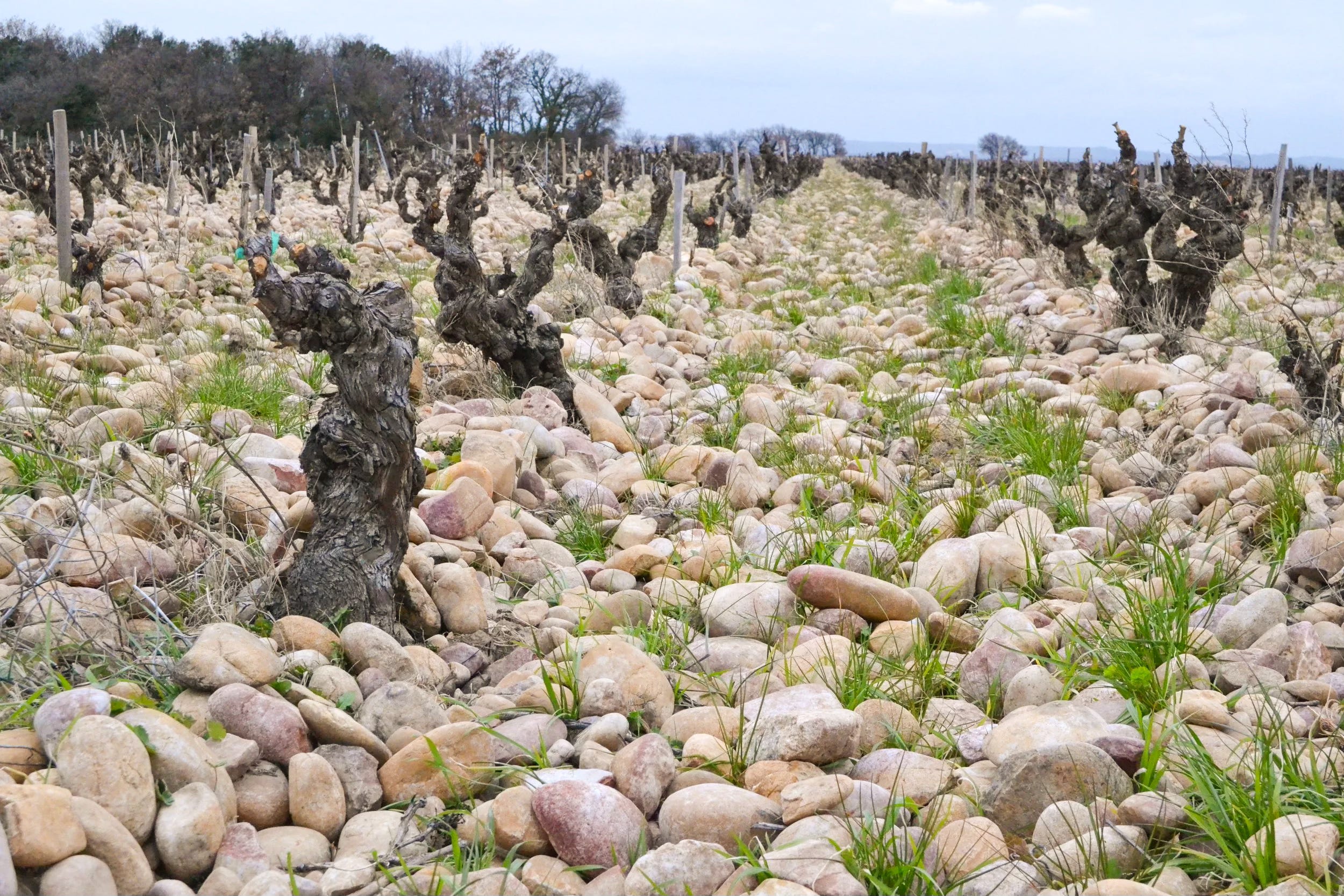
Pebble and cobble soils (including galets roulés), gravel beds, dark basaltic and lava-derived soils, iron-rich red soils, and exposed stony slopes.
The composition of soils can also impact how heat is absorbed and retained in a vineyard. Gravel, dark volcanic basalt and exposed schist surfaces can absorb and re-radiate solar energy, influencing the microclimate around the vine. In cooler climates, this additional warmth may assist ripening by elevating temperatures in the fruiting zone or accelerating soil warming in spring.
The magnitude of these effects is often overstated, particularly in warm regions where heat accumulation is rarely limiting. Nevertheless, thermal properties can shape phenological timing, influencing budbreak, flowering and veraison. Soil colour, stone content and albedo contribute to these dynamics. Heat retention may also affect microbial activity and root metabolism within the upper soil layers.
Alkaline and Acidic Soils
Alkaline (calcareous): limestone, chalk, marl, rendzina, calcareous clay and alluvium.
Acidic (siliceous or volcanic): granite-, gneiss- and schist-derived soils, sandstone, quartz-rich sands and certain volcanic ash soils.
Soil pH exerts a powerful influence on nutrient availability. Calcareous soils, rich in calcium carbonate, tend toward alkalinity. In such environments, iron availability can be reduced, leading to chlorosis if rootstocks are not adapted. Phosphorus solubility may also decline at high pH. Conversely, granite-derived and certain volcanic soils often weather into more acidic profiles, increasing availability of some micronutrients while potentially limiting others.


Soil pH shapes the nutritional environment of the vine, which in turn affects growth, photosynthetic efficiency and berry composition. However, the relationship between soil pH and wine pH is not direct. Must pH is primarily influenced by potassium uptake and acid metabolism within the grape, processes mediated by vine physiology rather than by simple chemical reflection of the soil.
Though pH is perhaps the most intuitively “chemical” of soil properties, the pathway from ground to glass is indirect and biologically mediated.
The Organic Component and Soil as a Gradient
This breakdown is far from perfect, and certainly not complete. It is also important to stress that these categories do not represent discreet bins by any stretch of the imagination, but rather traits on a gradient. Soils can consist of any number of combinations of the above, depending on historical erosion patterns and geological activity.
Furthermore two vineyards on entirely different parent materials may behave similarly if their drainage and nutrient profiles align. Conversely, two limestone sites may produce markedly different wines if one is shallow and compacted while the other allows deep root exploration. It is not the mineral identity of the rock that shapes wine, but the hydrological, chemical and structural behaviour of the soil.
Now, so far we have been discussing soil function in the context of physical and chemical properties of inorganic substrates, but though it has cropped up in the above discussion of CEC and nutrient rich soils, we have not mentioned soil biology and the role of organic matter. Though the physical properties of a soil dictate its broader structure and properties, these are often mediated by, and the frequently the product of, the biological components in the soil. Without fungal and bacterial enzymes for example, the release and uptake of bioavailable nutrients would be significantly diminished. In terms of soil temperature and moisture retention, the presence of a living cover is of far greater significance than the rock type beneath. Discussion therefore of what the geological composition of the soil is like, without the added context of the biology it supports is of limited value.

Final Thoughts
Writing this, I am reminded of the scene in the 2012 film Somm, where someone enthusiastically says, “Yeah, you like, lick rocks, have you never done that?”. While a funny moment, emblematic of the dedication and focus on detail and taste required for the Master Sommelier exam, I am not entirely convinced, and having read this far, you may not be either, that licking rocks tells us very much.
When it comes to the question of minerality, we can say with confidence is that it is not the taste of dissolved stone. Vines absorb nutrients as ions, not as fragments of granite or slate. Stones are inert. The route from soil to wine runs through water movement, nutrient availability, root depth and biological activity. It is a physiological pathway, after all, with vines creating, among other compounds, chemical aroma and flavour precursors from the various bioavailable nutrients they take up. Grapes, amazing though they are, do not contain concentrated rock juice.
Yet while that does not necessarily make the descriptor entirely meaningless, minerality is first and foremost a description of the wine. It is a word chosen by popular consensus to mean a certain, otherwise intangible combination of sensory inputs, and it should not be confused with, or necessarily linked to any particular geological trait of the soil it comes from. Of course, on tasting wine, we are perceiving the imprint of soils that regulate vigour and shape ripening, but it is all too easy to mistake what is a metaphor for a description of the mechanism behind the flavours of the wine.
I’m quite interested to hear what your thoughts are on this and what you associate with the term minerality. Do you find it a useful term?
Thanks for this. The persistence of the mistaken belief that vines directly upload chalk or granite or slate or whatever and that's what gives the taste of the wine is nothing short of mind-boggling.
Back in the 1970s when I was studying geology I don't ever remember anyone licking rocks, though there were some weird guys. Yes, they were almost all guys; only one or two girls in my classes. Anyway, while geology is not irrelevant, chemistry is more important, both in the soil and the fianl product. Minerality is a useful term to hint at the flavours beyond fruit, acids and tannin.