

Few things are quite as ubiquitous and ordinary as the common wine bottle. According to the FAO around 26 billion of them are made each year (as of 2018) and though there are many different shapes and sizes, the vast majority of them conform to the standard 750ml specification that we are all so familiar with. This particular quantity has been become so deeply embedded in the way wine is made, sold and consumed that we seldom stop to question why this particular format gained such popularity. After all, there is nothing particularly obvious about 750ml. Why is it, that out of all possible quantities did this rather peculiar one become the standard container for wine almost everywhere in the world? It is tempting to attribute it to a single historical quirk, and a common explanation that is often accepted as the truth is that 750ml corresponds to the lung capacity of your average glass blower. Yet this neat and evocative explanation simply is not good enough, and ignores a couple of simple facts. First of all, the average forced vital capacity (how much you can forcefully exhale) of a middle aged man is around 4 litres, and while the resistance of glass and other practicalities reduces how much can be breathed into molten glass, there is nothing that stops the glass blower from simply taking another breath. The limiting factor for the size of a glass vessel is after all not the capacity of the blowers lungs, but rather the amount of glass that can be supported on the blowpipe, and kept sufficiently warm to be malleable.
It is quite tempting to assume there is some deliberate logic to the sizing of standard wine bottle, but as much as we would like a simple explanation, the actual development of the modern standard appears to be the result of a series of technological and commercial developments converging on the bottle size and shape we are so familiar with today. It is this history that I want to take a closer look at in this article, in part to see whether this standard retains its relevance in a world where the social dynamics of food and beverage consumption are rapidly changing.
The Human Scale
The standardisation of units is nothing new. As soon as societies grew complex enough to trade beyond the boundaries of a single village or community, some common understanding of weight, length and volume became necessary. The ability to quickly agree on the meaning of a specific measure was, and remains to this day essential, allowing goods to be priced, duties to be levied and contracts to be enforced with some confidence that both parties are talking about the same thing. The differences inherent to the good traded dictated the form of measure to be used. Lengths and distances would often be compared to common human dimensions, though because human body proportions naturally vary, early civilisations quickly realised that both trading and construction required fixed physical standards. While measures like the cubit, originally the distance from a bent elbow to the tip of the middle finger, or the common foot, served as initial blueprints, standard equivalents sanctioned and defined by the authorities would quickly emerge and serve as the basis for trade and taxation.
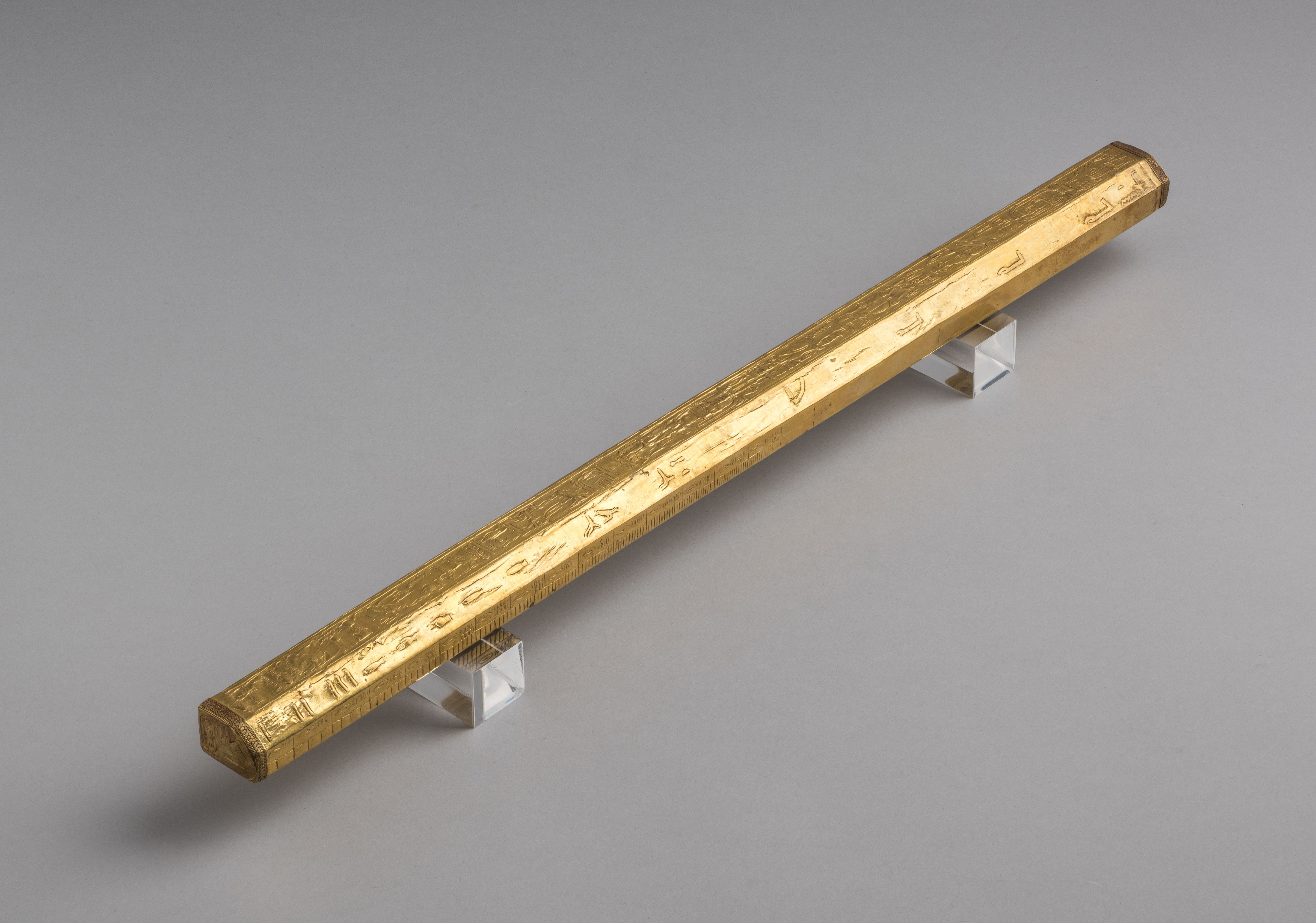
Volumetric measures are of course a bit more complicated, but would in ancient times often be linked to cubic units of length, much like today. One example is the roman amphora quadrantal, which measured one cubic foot, or about 26 litres. While a useful unit, such a quantity is of course far too large for household use, and subdivisions into more manageable volumes were needed. A sextarius, defined as 1/48th of an amphora quadrantal, or one sixth of a congius, became the standard volumetric unit of measurement because it bridged the gap between large standard containers and practical every-day household use. Measuring roughly 0.54 litres, it was a convenient size for daily individual rations, market transactions and cooking, and was used for both dry goods like grains and cereals and liquids like wine and oils.
That it is more or less the same size as a modern pint is also no coincidence, despite preceding it by over two millennia. While it would be a stretch to claim that there is a direct historical link between the roman measure and the modern pint, it is a clear example of the persistence of the human scale which largely dictates what quantities, particularly of consumable goods like ale and wine, are practical. This concept of the human scale is something we’ll come back to later.
The English Bottle
While glass has been around since antiquity, being developed and refined extensively both in Rome and in Syria, the making of glass bottles fell to the wayside during the Middle Ages, the majority of the glass trade being focused on window glass and drinking vessels rather than containers. Part of this was the relative fragility of medieval glass, which made any sizeable container much too insecure compared to equivalent earthenware vessels. By the early seventeenth century, a number of important developments occurred. According to B. E. Moody in this excellent paper from 1960 titled “The origin of the reputed quart’ and other measures” there were serious concerns, particularly from the admiralty, concerning the rate at which English glass makers were destroying forests to obtain wood fuel, threatening the supply of timber for ship building. This led to the development of coal as an alternative, which not only allowed for higher melting temperatures to be achieved, but also made glass-melting a cheaper process than it had been before. By 1615, the use of wood fuel for glass-melting was prohibited by law.
During this time, ex-Admiral and Treasurer of the Navy Sir Robert Mansell found an interest in the glass trade and decided to dedicate both his fortune and energies to glass, gaining a monopoly of the whole British glass industry by 1623. Once he had secured this monopoly of the trade, he set his eyes on competing with the imported stoneware bottles from the continent. To do so Mansell set about producing a strong, heavy glass bottle with as simple a design as possible, enabling it to be made quickly and cheaply. As the introduction of these bottles coincided with a time when the Puritans and Roundheads had significant sway, limiting the consumption of wine and alcohol in their efforts to combat the sin of drunkenness and excess, few examples of the early bottles were preserved. After the restoration of the Stuart monarchy in May 1660 however, wine once again flourished, and within a few years the sturdy English glass bottles had gained complete dominance of the market. By this time, Sir Mansell no longer held a monopoly, which he had lost in 1647.
While the glass bottle was in widespread use, it differed significantly from how we might think of it in a modern context. These bottles did not serve the function of a tradable unit containing a fixed measure of wine, but rather as vessels individuals could take to a wine merchant who filled them with wine from a cask using a liquid measure. In fact, the practice of selling wine by the bottle was prohibited by law in England in 1636, on account of there being too great a difference in the size and dimensions of the bottles used.
Over the years the glass bottle continued to evolve, changing from the round bulbous shape often compared to an onion, to longer-necked cylindrical versions more similar to those used today. By the late seventeenth century, taverns were selling wine in their own sealed bottles, with deposits charged for their return.
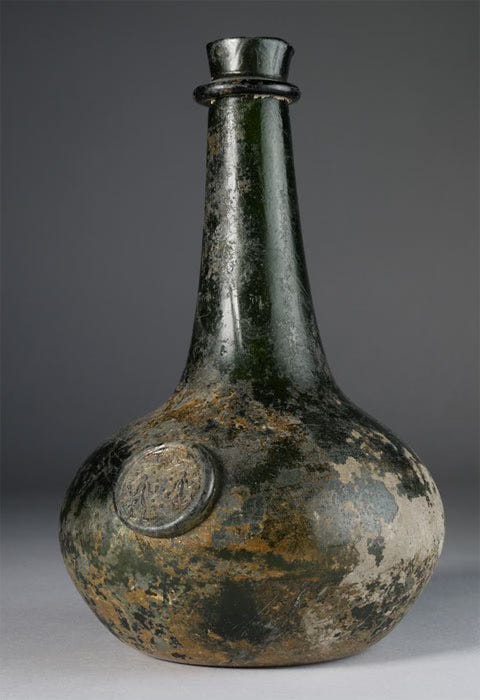
As the sale of wine in bottles became increasingly common over the following century, their highly variable bottle capacities became problematic once again. Over time however bottle-makers and merchants converged on a format that matched what was known as the reputed quart. Under the Queen Anne wine gallon of 3.785 litres, five reputed quart bottles were reckoned to the gallon, implying an ideal bottle of about 757ml and a 1793 statute explicitly treated five reputed quart bottles as one wine gallon.
While inventories for a Bristol glasshouse indicate that iron and brass bottles moulds were introduced as early as the 1730’s, it wasn’t until a Mr Henry Ricketts obtained a patent in 1821 for a three-piece mould which allowed the shaping of the neck, shoulders and body of a bottle in one go that standardised bottles at scale became possible. While some variation still existed on account of the glass maker collecting the glass for each bottle by hand, this technological advancement opened the door that eventually would lead to the bottle itself serving as the dominant unit of measurement for wine. Yet while precedent had been set by the commercial acceptance of the reputed quart in the sale and taxation of wine, there was no inherent rationale beyond adherence to consumer expectations and the human scale which determined what size a bottle should be. That however was about to change.

As the trade between Britain and Bordeaux became ever more important, a landmark French commercial law passed on 13 June, 1866 which legally standardised the regional capacities of wine barrels. Perhaps most famously, it codified the Bordeaux barrique as containing a minimum of 225 litres and the standard Bordeaux bottle as containing a minimum of 75cl. This regulation effectively formalised the conventions that were already in place, both with regard to the common barrique sizes in use, and the with regard to the normalised bottle in Britain being approximately one reputed quart or 757ml. While the new law still allowed for variation above these sizes, the abundance of 225 litre barriques being traded allowed merchants to conveniently invoice one barrique as 300 bottles or 25 cases of 12, without needing to account for awkward fractional remainders. As Bordeaux wine increasingly entered the international trade, this simple relationship between barrel and bottle provided a further incentive for merchants and bottlers to converge around a bottle containing approximately three-quarters of a litre.
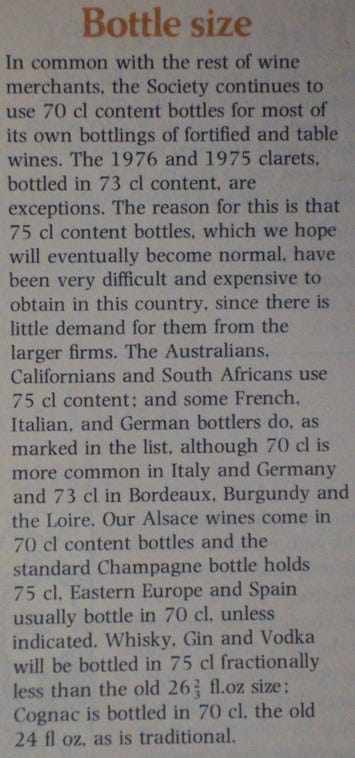
Even so there was no legal standard dictating this, and it was not until 1975 that the European Economic Community (EEC) passed Council Directive 75/106/EEC codifying the 750ml (75cl) wine bottle into law. This however operated under a legal framework known as optional harmonisation, and the standard did not become universally mandatory and legally binding across the entire European Union until 1 January 1989. The below news clipping from the Wine Society Spring List, May/September 1980 shows just how variable bottles were even then.
Eventually of course, and well before the 750ml standard was enforced by law in Europe, international trade had been influenced, leading to the United States officially adopting 1 January 1979 as the effective date for its own 750ml wine and liquor standard.
Final Thoughts
As I am writing this, I am eagerly awaiting my allocation of Chris Sciacca’s 2025 Vintage Orange Crush, which will come in half litre stoneware bottles. If you haven’t gotten on his list already, please check out his KapittelZwei project. This format, while allowing more bottles to be distributed from a small first vintage, is a nice reminder that 750ml, or multiples thereof, is not the only option available. With trade considerations aside, there is no single optimal size for a vessel, and the key criteria a bottle of wine has to satisfy is effectively a combination of practicality and ergonomics. Naturally, this means that there must exist a broad range of sizes that consumers, depending on their personal preferences and the intended occasion, would find optimal.


That said, trade and economics will ultimately determine which format is treated as standard, and despite suggestions that 750ml is simply too much wine for the modern consumer to commit to in one sitting, I am sceptical that another size will displace it any time soon. The first hurdle is infrastructure. Bottle manufacturers, bottling lines, labelling equipment, cardboard cases, cellar racks and retail shelving have all been built around the dimensions of the standard bottle, and departing from it at scale would prove to carry considerable complications for how the trade is organised. In addition, there are economics of scale involved, and the cost of packaging does not align perfectly with the amount of wine inside. In fact, the packaging costs per litre go up for smaller bottles as they still require the same closures, labels, cartons or shipping boxes, and broadly the same handling as larger formats. If environmental impact is the concern, lighter bottles or genuinely alternative packaging may offer more meaningful gains than simply dividing wine into smaller glass containers.
Yet there is no denying that smaller bottles serve a purpose and can be more practical. Many of wines competitors, come in single serving sizes that are very convenient for consumption taking place in third spaces (outside your home or work) where you may not be afforded the luxury, or time, of sitting down to share and enjoy a full bottle. The limited shelf life of an open bottle of wine also forces more rapid consumption of the whole volume, where spirits benefit from stability which allows a bottle to be consumed over a period of several months, if not longer. In such instances, smaller formats will, and do, make much more sense.
Ultimately, it comes down to practical considerations and the occasions for which the a bottle is intended. That is after all how we landed on 750ml in the first place. At the end of the day, the wine industry may benefit from returning to a mindset where the bottle, practical though it may be, is just a vehicle for the wine within. This might sound so obvious that it borders on the absurd, that is after all what a bottle does, but my point is that the format should surely be secondary to the wine it contains. If a smaller format sells more wine, what is the problem?
I will be taking my parents to Murano next month after harvest where we will visit some of the world’s best glassblowers. I will be sure to ask them and to report back. 😎👌
Another quiver to the “it’s not the glassblowers lung” bow: the ideal gas law.
Glass blowing is not like blowing up a balloon. Provided there is no mould into which the glass is being blown, which would make lung capacity irrelevant, the volume of air blown into a bead of glass will expand on its own due to the heat of the molten glass. If you look up glass blowers making something like a cup, they only give the lightest of puffs and then cap off the blow pipe then allow the heat from the glass to do the rest instead of huffing and puffing to fill all the space!
Though it still sounds a lot more poetic than detailing specific EEC legislature…